For Doctors
Key formulas
Parameter
Formula and explanation
Circulating blood volume (CBV)
Main formula:
For men: CBV = 0.417 · height³ + 0.045 · BW – 0.03
• For women: 0.414 · height³ + 0.0328 · BW – 0.033
(where BW is body weight in kg, height is in metres cubed; CBV is in litres)
Alternative formula:
CBV = M · k
(where M is body weight in kg, k is a coefficient equal to 65 for men and 60 for women; CBV is in millilitres)
Circulating plasma volume (CPV)
CPV = CBV · (1 – Ht)
(where Ht is haematocrit; CBV is circulating blood volume)
Na deficit
Na deficit (mM) = (142 - Naactual) · 0.2 · BW
(where Naactual is the patient’s concentration, BW is body weight)
K deficit
K deficit (mM) = (4 - Kactual) · 0.4 · BW
(where Kactual is the patient’s concentration, BW is body weight)
Leukocyte intoxication index (LII)
Prognostic index of hypotrophy (PIH)
PIH(%) = 140 - 1.5 · (A) - 1 · (AC) - 0.5 · (TSF) - 20 · (L)
(where A is albumin, AC is arm circumference, TSF is the triceps skinfold, L is lymphocytes)
Assessment criteria for PIH (Khoroshilov I.E., 1998):
0–20% — normal (eutrophy)
20–30% — grade I hypotrophy
30–50% — grade II hypotrophy
> 50% — grade III hypotrophy
Endogenous creatinine clearance (C)
(where U is the concentration of the substance in urine, V is minute diuresis, P is the concentration of the substance in blood)
Normal range (N)
90–130 ml/min (at a body surface area S = 1.73 m²)
About the procedure
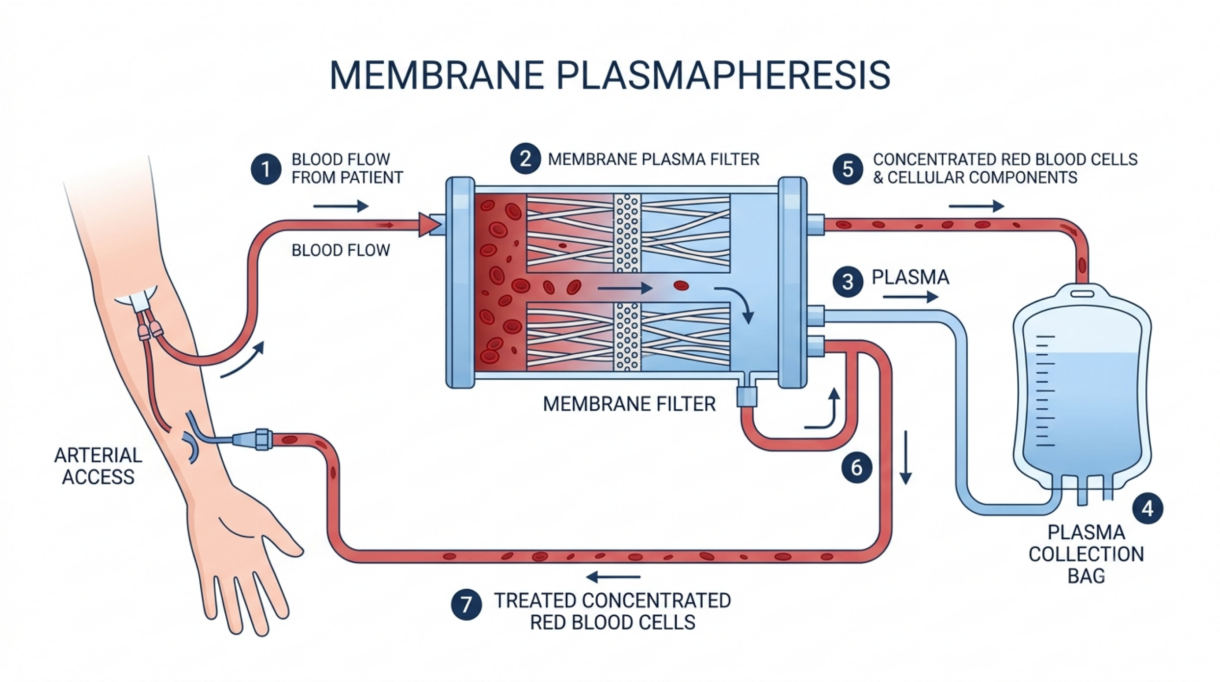
Plasmapheresis (from the Greek plasma — the liquid part of blood; apheresis — removal) is a form of extracorporeal therapy aimed at removing dialysable blood components while preserving its cellular elements. The method is used in the combined treatment of more than 200 conditions in whose aetiology and pathogenesis exogenous or endogenous intoxication, or the accumulation of metabolic products, plays a leading role.
The SAN Centre for Detoxification and Efferent Therapy uses continuous, or flow-through, membrane plasmapheresis — a method that is safe, comfortable and atraumatic for the cellular elements of blood. As prescribed by the physician, membrane plasmapheresis may be combined with parallel extracorporeal pharmacotherapy, laser immunocorrection, ultraviolet irradiation or ozonation of the blood.
Membrane plasmapheresis is performed on a dedicated device (for example, the AMPld TT Hemofenix) using single-use plasma filters, an extracorporeal circuit (a disposable set of tubing lines) and an individual set of plasma-substituting solutions and anticoagulants, in the intensive care unit of the VitaCentre clinic.
During plasmapheresis, alongside detoxification, the following processes take place:
Relief of the body’s excretory organs and systems.
Cleansing of the plasma membrane of the cellular elements of blood.
An increase in the elasticity coefficient of blood cell membranes.
Improvement of blood rheology, microcirculation and systemic haemodynamics.
Stimulation of immunogenesis.
Unblocking of receptors and an increase in their functional activity in haematopoietic, phagocytic and immunocompetent cells.
Normalisation of oxygen metabolism and tissue respiration.
Stimulation of antithrombin activity and fibrinolysis.
Normalisation of the permeability of the basement membrane of the renal glomeruli, a reduction in proteinuria and normalisation of the proteinogram.
An antihypoxic effect, which has been clinically proven.
Protection against the effects of end products of lipid peroxidation and intoxication products.
Normalisation of the hormonal function of the hypothalamus, the pituitary gland, the adrenal glands and the ovarian system.
VASCULAR ACCESS — the cubital veins
THE VOLUME of plasma removed in a single session is calculated by the unit’s intensive care physician on the basis of body weight, haematocrit and biochemical parameters. The volume of plasma removed is usually between 500 ml and 700 ml.
THE VOLUME of blood in the extracorporeal circuit is 60–120 ml, which the patient does not feel at all. After the procedure, the entire cell mass is returned from the line to the patient’s bloodstream.
MODE OF DELIVERY — isovolaemic; there is no blood loss.
AGENTS USED: anticoagulants — Na citrate; heparin (5,000–10,000 units);
PLASMA REPLACEMENT:
- Crystalloids (Ringer’s solution, saline);
- Dextrans (rheopolyglucin);
- HES solutions — hydroxyethyl starch (Voluven);
- Protein solutions (albumin);
- Marked organic changes in the cardiovascular system and the CNS;
- unstable haemodynamics
- Bleeding;
- Absence of venous access;
- phlebitis of the peripheral veins in the acute stage;
- Allergic reactions to anticoagulants, colloid and protein preparations;
- Anaemia (Hb<90 g/l); thrombocytopenia (platelets <100 × 10⁹/l);
- Hypoproteinaemia (total protein <65 g/l);
- Hypocoagulation;
Points to note
Plasmapheresis in children: for children weighing more than 40 kg, with normal protein levels and a normal haemostasiogram, the procedure is performed as in adults. For children of lower weight it is used only on clear indications (acute poisoning); for those weighing less than 10 kg the procedure is performed by the syringe method in an inpatient setting.
The coagulation system during plasmapheresis. Replacing the removed plasma with saline solutions, dextrans and/or albumin lowers the patient’s clotting factors. The extent of that reduction depends on the volume of apheresis. After one to three sessions patients show no haemostatic disturbances unless they had severe thrombocytopenia or a bleeding tendency beforehand. For such patients replacement is carried out mainly with fresh frozen plasma (FFP). In patients with normal synthesis it takes 24–48 hours for clotting factors to return to their baseline level, which the efferent therapy physician allows for when planning the course.
The concentration of all plasma components falls in proportion to the volume of plasmapheresis, except for those contained in the replacement solutions. This may affect drug activity as follows:
removal of drugs together with the plasma may lower their concentration below the therapeutic level (examples of such drugs are digitoxin, cyclophosphamide, prednisolone and vibramycin);
removal of plasma components may disturb the metabolism or activity of medicines. (For example, removing antibodies to acetylcholine receptors can substantially increase the activity of anticholinesterase mediators. Conversely, plasmapheresis removes pseudocholinesterase along with the plasma, so the use of neuromuscular blockers leads to prolonged blockade, even for several days after the last session.)
Plasmapheresis is extremely effective when performed before a course of medication is prescribed, during remission.
Plasmapheresis is most often the method of choice in fulminant disease and in a torpid course (a sluggish process that does not respond to drug therapy). PLEASE NOTE: performing plasmapheresis at the peak of effective drug therapy is inadvisable. It is performed in cases of intoxication (overdose) with the active agent, as a single session.
Number of sessions
A proven clinical effect and a guaranteed improvement in laboratory values are achieved by removing 1–1.5 CPV (circulating plasma volume). That is 2–4 plasmapheresis sessions. A course may reach 7–8 sessions. The number can be reduced by combining plasmapheresis with haemosorption and/or infusion therapy. The interval between procedures is 1–3 days; between courses, at least 1.5–2 months. SINGLE procedures are performed for preventive purposes (for example, during a seasonal flare-up), in acute exogenous (uncomplicated) poisoning, after courses of highly toxic drugs (biltricide, for instance), and before the planned start of treatment (in venereology, for example).
Contraindications for plasmapheresis
LABORATORY TESTS REQUIRED FOR PLASMAPHERESIS:
Mandatory:
- Full blood count;
- Total protein;
- Albumin;
PTI (prothrombin index);
Fibrinogen;
In addition — every diagnostically and pathogenetically significant parameter for the individual patient. During a long course of plasmapheresis the mandatory parameters are checked after the third session, or after apheresis of more than 1.5 CPV. Two days after the course ends, a clinical and laboratory examination is carried out to assess how the values have changed.
INDICATIONS FOR OUTPATIENT PLASMAPHERESIS:
- No response to therapy;
- Reducing the volume and increasing the effectiveness of standard drug therapy;
- Lowering tolerance to medicines;
- The introductory phase of a planned course of immunosuppressive therapy;
- Hypercholesterolaemia with a high level of low-density lipoproteins;
- Drug-induced hepatitis with hyperenzymaemia, eosinophilia and leukopenia;
- Raised AST, ALT, ALP and bilirubin in the blood plasma;
- Polyvalent allergy;
- A long-standing history of infection;
- Refractoriness to antihypertensive drugs;
- Hypercoagulation (blood hyperviscosity);
- Contraindications or tolerance to corticosteroids and/or anticholinesterase drugs;
- Prevention of gestosis;
- Autoimmune disorders (including APS, anti-hCG and others);
- Sympathoadrenal crises (raised blood pressure, changes in heart rate, vomiting, polyuria);
- Hot flushes, sleep disturbance, irritability, weakness, sweating;
- Refractory skin itching;
Technological basis of extracorporeal haemocorrection procedures
Technology
Type of procedure
Membrane
Haemodialysis, ultrafiltration, haemofiltration, haemodiafiltration, plasma filtration, haemoxygenation
Centrifugal
Plasmapheresis: discrete, hardware; leukocytapheresis, thrombocytapheresis, erythrocytapheresis
Sorption
Haemosorption, plasmasorption, lymphosorption, xenoperfusion
Precipitation
Acid heparin precipitation
Cryoprecipitation (cryoapheresis)
Cryoplasmasorption
Thermoprecipitation (thermofiltration)
Thermoplasmasorption
Electromagnetic
Blood photomodification (ultraviolet and laser irradiation of blood, irradiation with visible light)
Magnetic treatment of blood
X-ray irradiation of blood
Electrochemical
Indirect electrochemical oxidation of blood
Ozonation of blood
Endogenous creatinine clearance (C)
(where U is the concentration of the substance in urine, V is minute diuresis, P is the concentration of the substance in blood)
Normal range (N)
90–130 ml/min (at a body surface area S = 1.73 m²)
Principal specific action of extracorporeal procedures
Type of procedure
Detoxification
Rheocorrection
Immunocorrection
Haemodialysis
+++
+
–
Haemosorption
+++
+
+
Plasmapheresis
++
+++
+++
Plasmasorption
++
+
+
Xenoperfusion
+
–
+
ECDS
–
–
++
Ultrafiltration
–
–
–
Haemofiltration
+++
+
+
Haemoxygenation
+
+
–
Blood photomodification
+
+
+
IEOB
+++
+
++
(depending on the NaClO concentration)
Key: +++ high efficacy; ++ moderate efficacy; + low efficacy; – the method is ineffective.
Distribution of water across the body’s fluid compartments
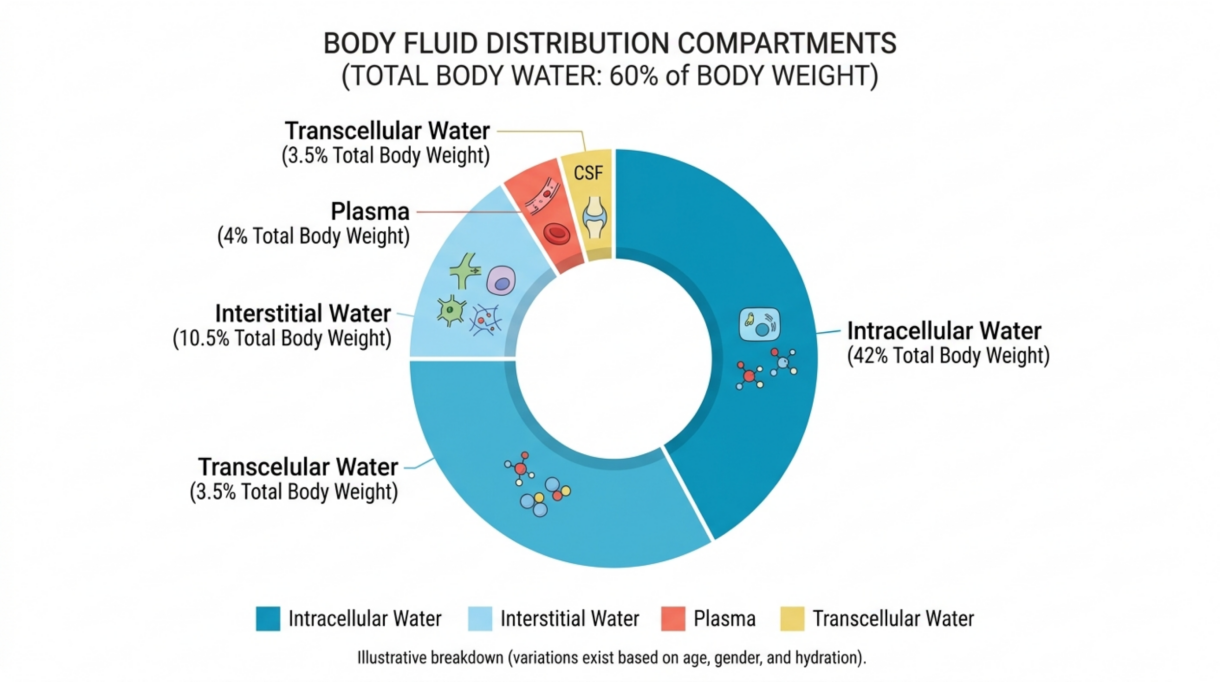
“Dry weight” (40% — 28 kg)
The circulating plasma volume (CPV) is about 4% of body weight.
Interstitial water (10.5% — 7.35 l)
The high efficacy of plasmapheresis when 30% of the CPV is removed is due to the “emergency interstitial drainage mechanism”: after plasma replacement with crystalloids, fluid together with toxins moves from the interstitial space into the vascular bed.
Transcellular water (3.5% — 2.5 l)
A course of plasmapheresis makes it possible to “cleanse the body” effectively thanks to the mechanism described above.
Blood plasma (4% — 2.8 l)
Protein loss during the procedure is usually of no clinical significance, except in cases of severe hypoproteinaemia in debilitated oncology patients who require nutritional support (Nutrison or Berlamin, for example).
Intracellular water (42% — 30 l)
The baseline plasma protein level is restored within 24 hours; this is what determines the interval between membrane plasmapheresis sessions.
Book a free consultation with a specialist
Book a consultation